Overview
The Contract dashboard is your window into your contract inventory and past performance library. It has multiple views and filters to choose from, giving you great flexibility into your data and how you view it.
Use the Contracts and Documents tabs at the top of the page to switch between your contracts and the documents attached to them. In the top right, the gear icon opens Contract settings (see Customizing Contracts). You only see the gear icon if you can manage Contract settings. To build reports from your contracts, select Reports in the left-hand navigation menu (see Using the Reports Center).
Views
To change views, click Customize in the top right of the table and choose a layout under Layout: Expandable, Table or Gantt. To open the Contract Inventory in that layout every time, click Set Default.
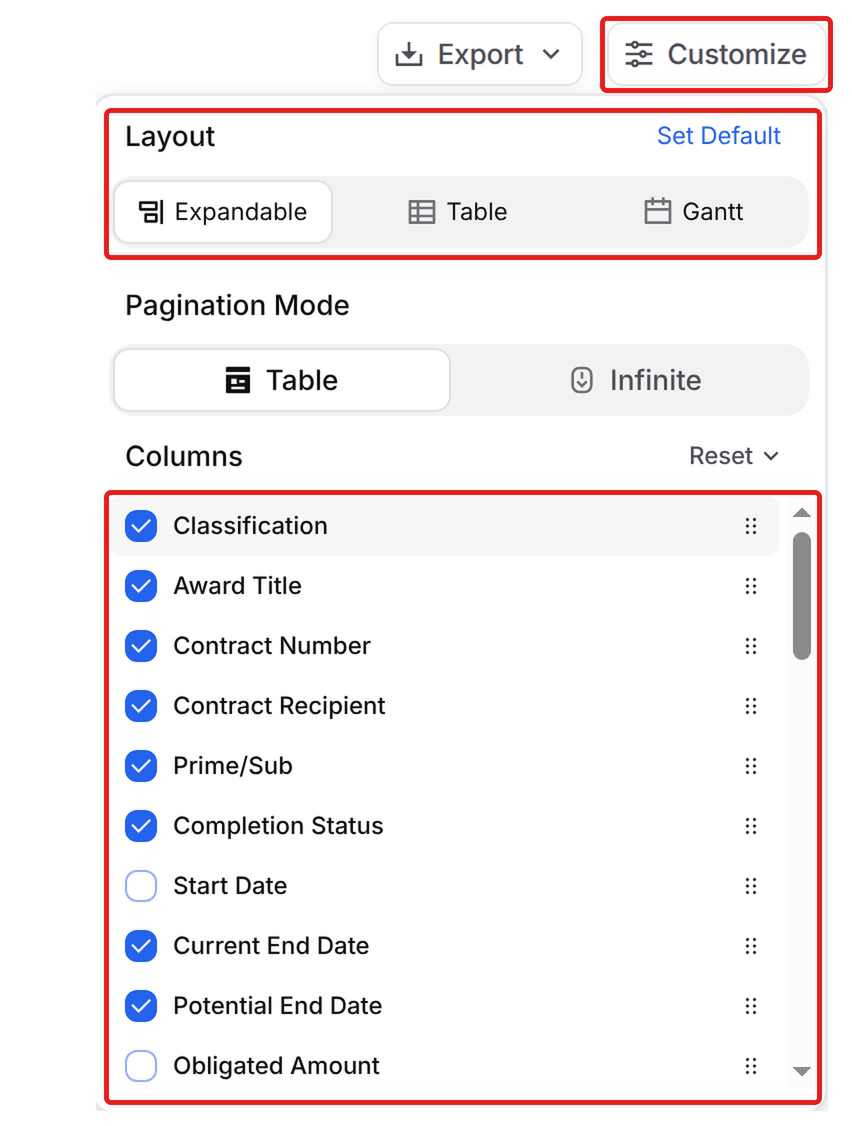
By default, the Contract Inventory is displayed in the Expandable View. This view provides you with the ability to quickly visualize the relationships between your contracts and task orders. The arrow indicator on the left of a contract (when illuminated) will allow you to expand and collapse contracts and their associated task orders. All task orders will appear underneath the parent contract, as shown in the screenshot below.

The Table View shows your entire contract inventory within a single table. This will not display any associations between contracts.
The Gantt view will display your period of performance start and end dates visually within a horizontally oriented calendar.
In the same Customize menu, choose Table under Pagination Mode to page through your contracts, or Infinite to keep scrolling. Under Columns, check or uncheck a column to show or hide it, drag the dots to reorder columns, and click Reset > Order or Visibility to go back to the default column order or the default shown columns.
Modification and Points of Contact Columns
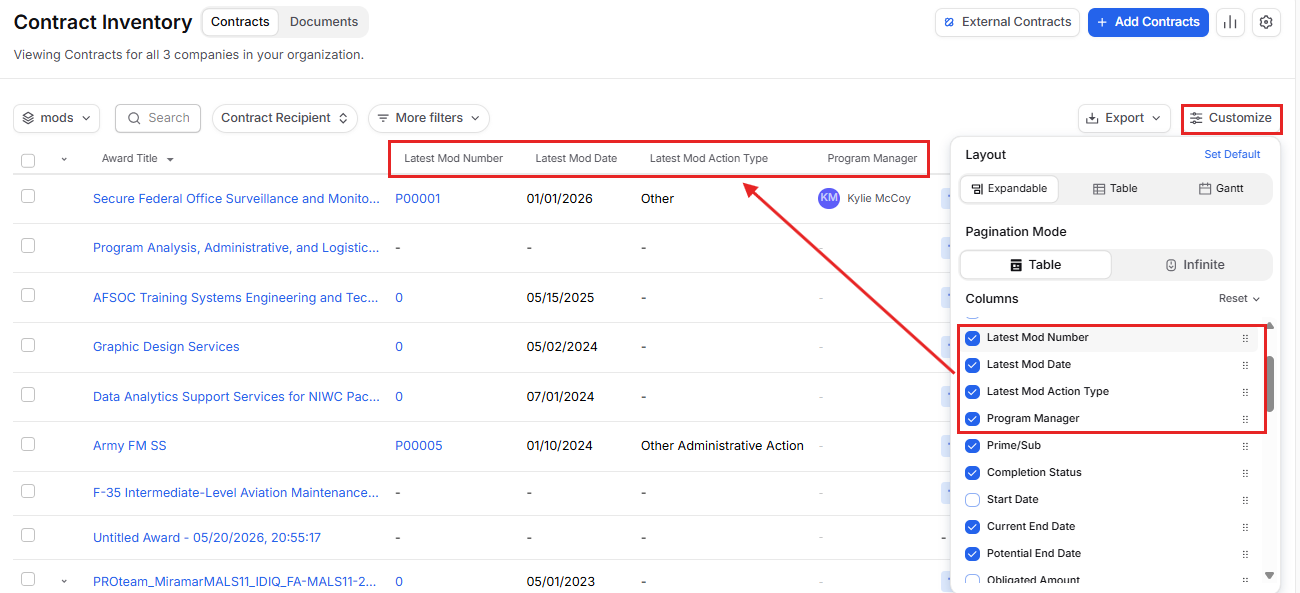
Several columns are hidden by default and can be turned on from the Customize menu whenever you need them:
Latest Mod Number: The modification number of the most recent modification on the award. Click it to jump straight to that modification's details.
Latest Mod Date: The action date of the most recent modification.
Latest Mod Action Type: The reason for the most recent modification (for example, a funding or period of performance change).
One column per Points of Contact role: Every role configured for your workspace (for example, Program Manager, Contract Manager, Contracting Officer, and Contracting Officer Representative) appears as its own column showing only the people assigned to that role on each award. When more than one person holds the role, the column shows their avatars with a count; hover over it to see every name.
Awards without a modification or without anyone assigned to a role display a dash.
External Contracts
Click External Contracts in the top right of the page to see contracts performed by companies outside your organization. To learn more about how to manage these, see our support article here.

Saved Views
You can save specific sets of filters as views that can be easily recalled or set as your default view. To create a view, set your desired filters (due dates, roles, award types, custom fields, anything that filters your current contracts), and then click Save and choose Save as New View in the top right of the filter bar.

Next, provide the view a name, set your visibility preference (personal or team view), and then your default view preference.
Recalling, Managing, And Editing Views
To recall your saved views, click the views menu at the top left of the table (it shows All Items until you choose a view). You can also manage your views here by clicking Manage Views, which will provide you with a list of your views you can rename, set as default, or toggle the private/team visibility preference.
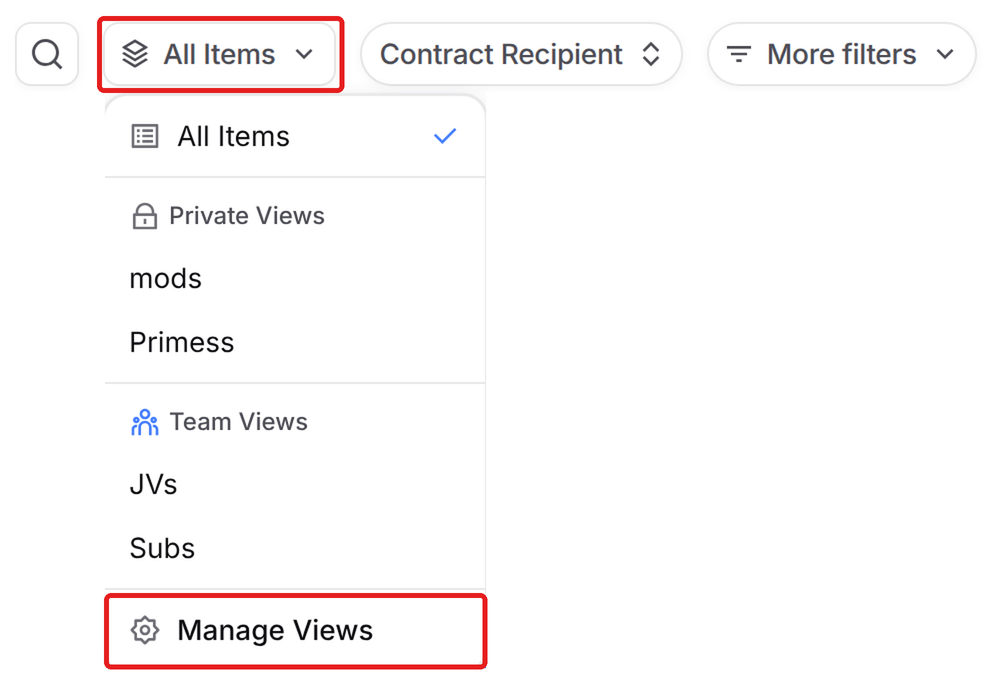
If you make any adjustments to your saved view while it’s currently set (such as adding or removing filters), you can either save the changes to the view or create a new view using the Save button as shown above. To clear your filter changes, click Reset.
Dash and Search
Click the search icon at the top left of the table to search by keyword and filter your contract inventory list.

Within the Contract dashboard, Dash helps you find, understand, and manage your contract inventory. Click the blue circle in the bottom-right corner to open Dash.

Ask Dash to find and summarize contracts, answer questions using contract records and documents, and help keep your inventory current. With the appropriate access, Dash can create, update, or delete contract records, manage contract modifications, organize documents already stored in GovDash, identify key contract documents, and explain changes recorded in an award's Audit Log. Before deleting, Dash tells you which contracts it will remove and waits for you to confirm.
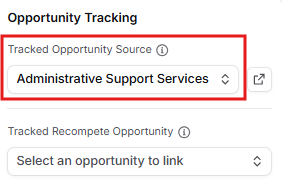
If a contract's Opportunity Tracking card is linked to the opportunity it came from or to a recompete you are pursuing, Dash can also tell you about that opportunity and its solicitation documents. Dash treats the contract's own documents, such as the signed PWS/SOW and the contract award, as the final word on scope, and uses solicitation documents as background.
Try prompts like:
Show our active Army contracts ending in the next six months and summarize the key details.
Create a funding modification for Enterprise IT Support and update the contract's current period end date.
Attach the Data Library document "September Status Report" to Enterprise IT Support and mark the attached PWS as the PWS/SOW.
What opportunity did Enterprise IT Support come from, and what did its solicitation ask for?
Dash cites the records it uses so you can select Check sources to review the underlying information. Changes made by Dash appear in the contract record and are captured in the Audit Log.
Dash cannot upload a new file from your computer. Upload it through the contract's Documents tab or the Data Library first, then ask Dash to work with it. Available actions depend on your permissions and the sources enabled in Dash.
Changing key documents?
You need permission to edit sensitive contract details to set or clear a document's primary relationship. To learn more about uploading files and managing key documents directly, see Managing Your Contract Inventory.
Learn More about Dash
To learn more about Dash and how to best utilize it within GovDash, see our guides here.
Exports
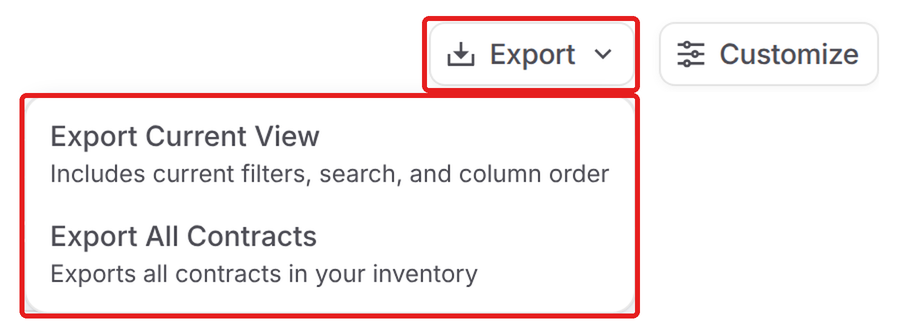
Click Export and choose Export Current View to download your contracts with your current filters, search and the columns you have showing, in the same order, or Export All Contracts to download your whole inventory with every column. If you check contracts in the table first, you can also choose Export Selected to download just those contracts with every column. The file downloads as an Excel spreadsheet (.xlsx).
Your spreadsheet uses the same column names as your contracts table, including one column for each Points of Contact role (for example, Program Manager) listing everyone assigned to that role, plus your custom fields. Each contract's Title links straight back to that contract in GovDash.
FAQ
What features does the Contract dashboard offer for managing contracts?
The Contract dashboard provides multiple views, filters, and customization options to help manage and visualize your contract inventory effectively.
How do I create a new saved view in the Contract dashboard?
To create a new saved view, set your desired filters and click Save, then Save as New View in the filter bar.
What is the purpose of Dash in the Contract dashboard?
Dash allows you to ask questions about your contract inventory and receive detailed answers regarding capabilities, dates, and document details. You can also ask Dash to create, update, or delete a contract award (Dash confirms with you before deleting), attach an existing GovDash document, detach a linked document, set an attached file as the original contract document or PWS/SOW, tell you who changed what on a contract, or tell you about the source or recompete opportunity linked to a contract. Upload new files through the contract's Documents tab or the Data Library first.
Can I adjust the visibility settings of my saved views?
Yes, you can set your saved views to be either personal or team views, allowing for flexible visibility options.
Is it possible to modify an existing saved view after creating it?
Yes, you can make adjustments to an existing saved view and either save the changes or create a new view.