Understanding Credits, Usage, and Billing in GovDash
GovDash credits provide a shared way for your workspace to use AI-powered features whose cost varies based on the work performed.
Credits belong to the workspace, not to an individual member. Purchases, usage charges, refunds, grants, and support adjustments all update the same shared workspace balance.
Purchased credits do not expire.
GovDash reports usage in credits rather than displaying technical information such as token counts, model prices, or internal processing costs.
Important: The features that use credits depend on your workspace’s product subscriptions and beta rollout status. Notices displayed in GovDash reflect the billing rules currently applying to your workspace.
What Uses Credits?
Credit usage depends on whether your workspace has a GovDash platform subscription and which product areas the subscription covers.
Workspaces Without a Platform Subscription
After paid credit billing is enabled for your workspace, credits are used for:
Agent runs, based on the work performed during each run
Dash chat
Team-initiated AI work in product areas that are not covered by a subscription
Routine product activity does not use credits. This includes creating, storing, organizing, and viewing your team’s data. Non-AI workflows, storage, and document processing also do not use credits.
The billing notices and credit controls displayed in GovDash indicate when paid credit billing is active for your workspace.
Workspaces With Platform Subscriptions
When your workspace subscribes to a GovDash product area:
Team-initiated AI work in that product area is included.
Dash chat is included.
Agent runs use credits because Agents are an optional, variable-usage extension of the platform.
Platform subscribers use 25% fewer credits for the same Agent work.
AI work outside a subscribed product area may use credits.
During the beta transition, GovDash may cover Agent usage for eligible platform subscribers. The notice displayed in GovDash explains whether your workspace’s Agent usage is currently covered and shows any applicable dates.
When a discount or beta coverage applies, GovDash may show both the original credit amount and the adjusted amount. The adjusted amount is the amount actually charged to your workspace balance.
Seeing Credit Coverage Before You Start
You do not have to check your plan to know how an action will be billed. Wherever GovDash is about to start AI-powered work, a credit indicator appears next to the button that starts it.
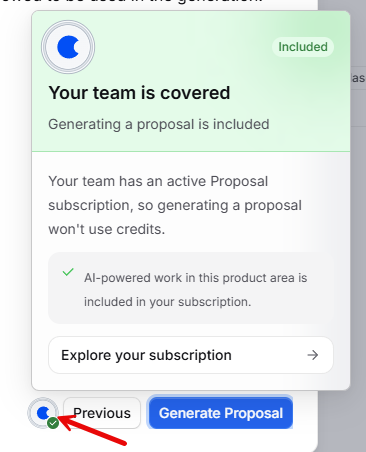
Hover the icon to see how the action applies to your workspace:
Included — your team has an active subscription for that product area, so the action will not use credits.
Uses credits — credits are consumed only when GovDash performs the work.
Either way, the panel includes a link to Settings → Billing → Credits → Plans Subtab so you can review your coverage without leaving the workflow.
View Your Workspace’s Usage
All workspace members can review metered activity from the Usage page.
Open Settings.
Under Billing, select Usage.
Choose the last 7, 30, 90, or 365 days, or select All time.
Review the usage summary and activity details.
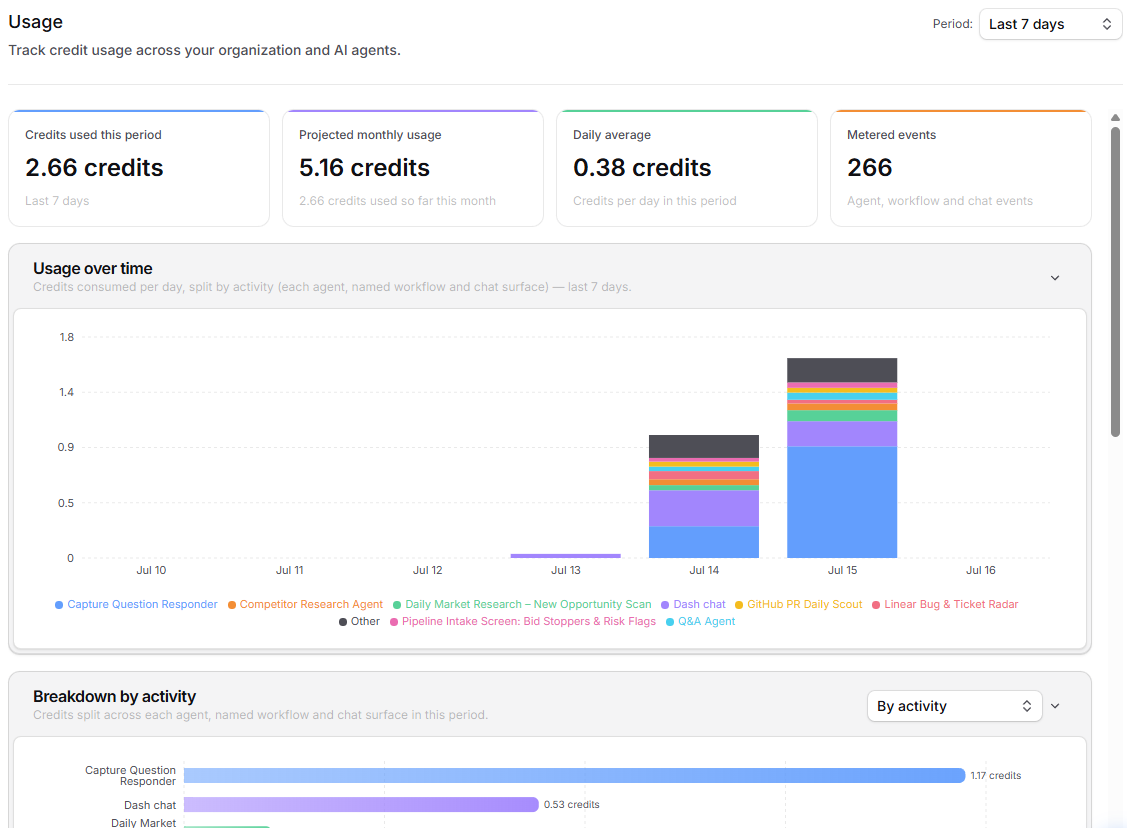
The Usage page includes information such as:
Credits used during the selected period
Month-to-date and projected monthly usage
Average credits used per day
The number of metered events
Usage over time
Breakdowns by activity and source
Details for each Agent, named workflow, and chat surface
Understanding Monthly Projections
Monthly projections are directional estimates based on recent activity. They are not guaranteed totals and may increase or decrease as your workspace’s usage patterns change.
Why Usage May Differ From Transaction History
The Usage page reports the amount of work GovDash measured in credits. It does not necessarily show the amount deducted from your workspace balance.
Transaction history records changes that were applied to the balance. Several factors can cause the two totals to differ:
Platform subscription coverage
Beta coverage
Subscriber discounts
Refunds or support adjustments
Transaction processing and settlement timing
For example, an Agent run may appear on the Usage page at its original metered amount, while transaction history shows a lower amount after the platform subscriber discount is applied.
Review Plans and Subscriptions
All workspace members can open Settings → Billing → Credits → Plans Subtab to understand how platform subscriptions and credits apply to the workspace.
From the Plans page, you can:
Review the current plan for each available product area
Compare platform subscriptions with credit-based usage
See which actions are included and which may use credits
Contact GovDash Sales about an available subscription upgrade
Submitting an upgrade request does not automatically purchase or change a platform subscription. A GovDash representative will follow up with your team to discuss the request.
Check Your Balance and Transaction History
Workspace administrators can open Settings → Billing → Credits → History Subtab to review the shared credit balance and billing activity.
Depending on your workspace’s beta billing experience, the Credits page may include:
The current shared credit balance
Your workspace’s billing policy
Available prepaid credit packs
A link for managing payment methods and billing details
Transaction history for purchases, grants, Agent runs, named workflows, chat, refunds, and support adjustments
How Refunds Appear in Transaction History
Transaction history is append-only so billing activity remains auditable. Completed transactions are not replaced or rewritten.
When GovDash returns credits, the refund appears as a separate transaction alongside the original charge.
Purchase Credits
Credit purchases are available only to workspace administrators and only when purchasing has been enabled for the workspace.
To purchase credits:
Go to Settings → Billing → Credits.
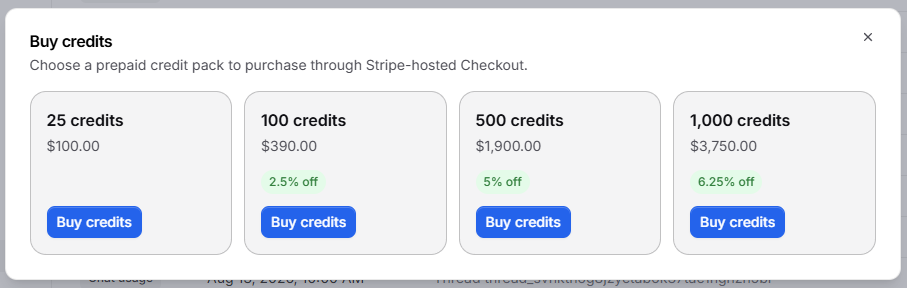
Select Buy credits in the top right corner, and then choose your desired number of credits to buy.
Confirm that you are leaving GovDash and continuing to Stripe, GovDash’s approved payment processor.
Complete the payment in Stripe Checkout.
Return to GovDash.
Your workspace balance updates after Stripe confirms the payment and GovDash processes the purchase.
Available pack sizes, prices, and volume discounts are displayed before checkout. If no credit packs have been configured for your workspace, the purchase controls will not appear.
Manage Payment and Billing Information
Select Manage billing from the Credits page to open the Stripe Customer Portal. You will be asked to confirm that you are leaving GovDash before being redirected.
The Stripe Customer Portal can be used to manage supported payment and billing information, including saved payment methods and receipts. GovDash does not collect or display full payment card details.
Setting Credit Limits
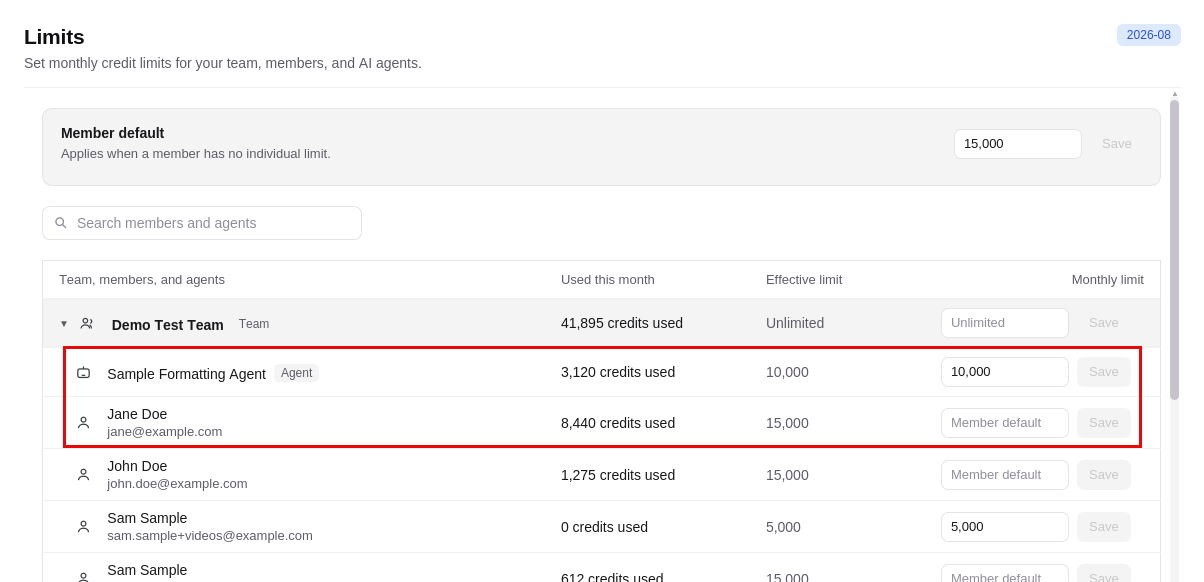
Setting credit limits allows your team to control the amount of credits used by the entire team, specific users, and agents. Navigate to Settings → Billing → Credits → Limits Subtab to access the Limits dashboard.
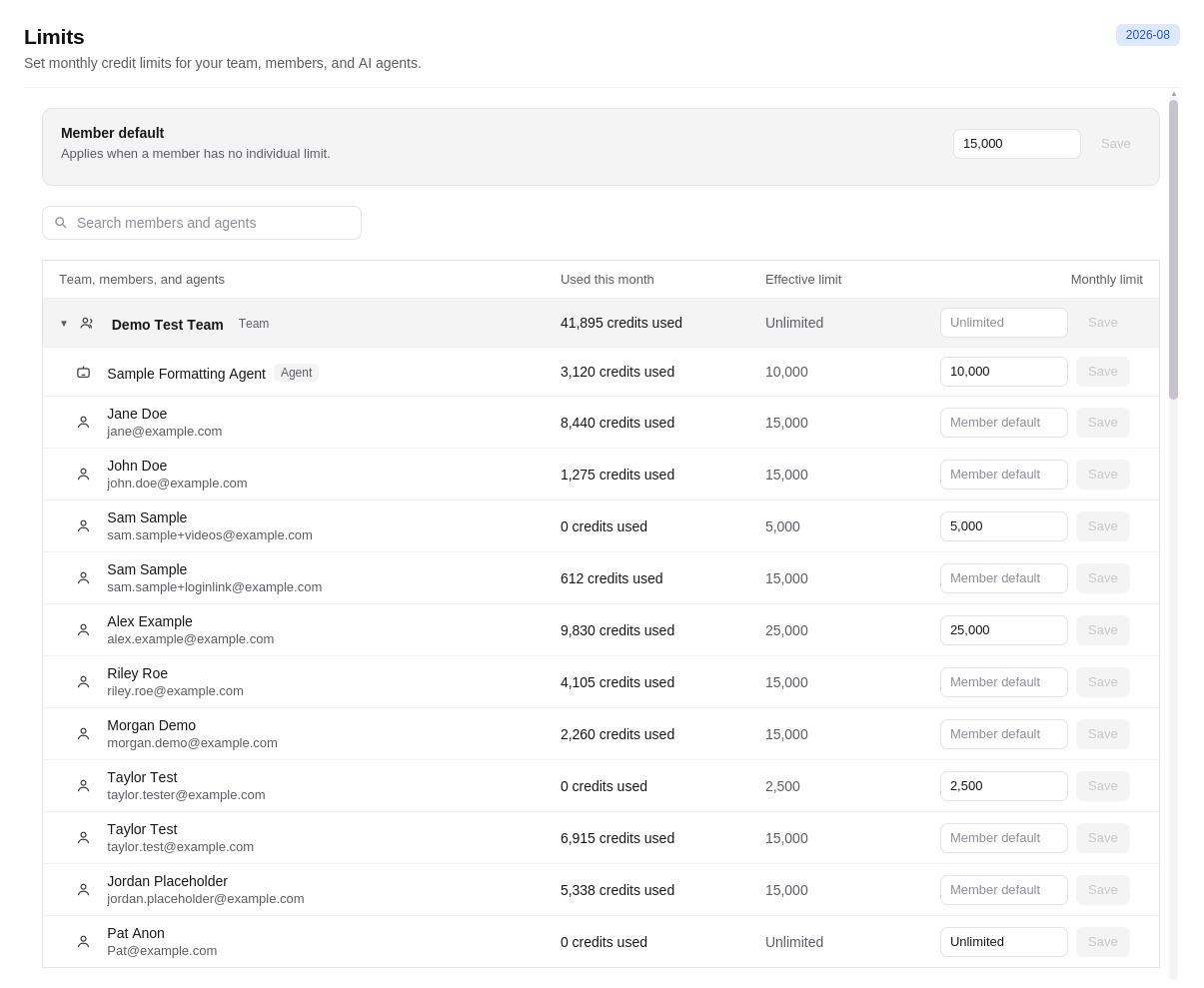
For any member, the enforced limit is the first of these that exists:
An individual monthly limit on that member's row
The member default
No cap, if neither is set
The Effective limit column always shows the result, so you can confirm what is actually being enforced without tracing the logic yourself.
Setting Member Defaults
Set this once in the card at the top of the page. It applies to every member who does not have an individual limit, which makes it the fastest way to cap a whole team. Changing it immediately updates the Effective limit for everyone still on the default. Leave it as Unlimited if you only want to cap specific people. If you need to adjust it back to Unlimited, remove all numbers from the field and hit Save.

Setting Individual User and Agent Defaults
Enter a value in that member's Monthly limit field and click Save on the same row. Each row saves independently, so you can adjust one person without touching anyone else. Two things to read off the field:
Placeholder text reading "Member default" means the member default is currently set
A value in the field means the member has an override, and the member default no longer applies to them
Agents appear as their own rows and are capped separately. They do not inherit the member default, so their field reads Unlimited until you set a value.
What Happens When the Credit Balance Is Low?
When credit enforcement is active, GovDash provides a small, centrally configured overdraft allowance. This is intended to let work already in progress finish when the workspace balance crosses zero.
The following rules apply:
New metered work is blocked after the workspace reaches the configured credit floor and has no additional billing option available.
Features included with a platform subscription are not blocked by the credit balance.
Work already in progress is normally allowed to finish.
An Agent run may be stopped and marked Terminated if its projected usage moves significantly beyond the allowed overdraft.
Workspace administrators may receive low-balance, zero-balance, overdraft-warning, and excessive-run notifications.
Overdrafts: The overdraft allowance is configured by GovDash. Workspace administrators cannot change this, but spending limits are fully configurable.
If the workspace balance prevents new work from starting, contact a workspace administrator. The administrator can purchase credits when purchasing is available or contact GovDash Support.
Refunds and Failed Work
GovDash automatically returns credits for eligible system-caused failures, including certain failures involving an AI provider.
Credits may still be charged when:
A team member cancels work after processing has started.
A failure is not eligible for an automatic refund.
GovDash completed part of the requested work before the cancellation or failure occurred.
In these situations, the workspace may be charged for the work that was already performed.
FAQ
Do credits expire?
No. Purchased credits do not expire.
Can one member purchase credits for only themselves?
No. Credits are held in a shared workspace balance. Only workspace administrators can purchase or manage them.
Why does Usage differ from transaction history?
Usage shows metered AI activity. Transaction history shows settled balance changes. In-progress work, settlement timing, discounts, and refunds can cause temporary or expected differences.
Will running out of credits stop included subscriber features?
No. Manual named workflows and Dash chat that are included with a platform subscription do not route through credit enforcement. Dash agent runs remain metered for all workspace types.
How do I know whether an action will use credits?
Look for the credit indicator next to the button that starts the work, for example when generating a capability matrix, submitting a proposal draft for outline generation, or generating a proposal. Hover it to see whether the action is Included with your subscription or Uses credits.
Why was an agent run system terminated?
GovDash normally lets in-progress work finish, even after the balance crosses zero. A run is system terminated only when it moves far beyond the configured overdraft allowance. Contact a workspace administrator or GovDash Support if the termination appears unexpected.
Which payment methods can I use to buy credits?
Stripe Checkout accepts credit cards, Link, and ACH bank transfers from a U.S. bank account. Choose whichever your finance team prefers, the credits and pricing are the same.
I paid by bank transfer. Why is my balance unchanged?
Bank transfers clear in a few business days, so your balance updates after the transfer succeeds rather than at checkout. Until then you will see the Payment processing notice on the Credits page. If a transfer fails, no credits are added, so check your Stripe receipts and start the purchase again.
Where can I get help?
Contact your GovDash representative or Support. Include the workspace name, approximate time, affected workflow or agent, and any transaction or run identifier shown in GovDash. Do not send card details.