Overview
Use Deliverables to track what a contract requires you to deliver, such as CDRLs, monthly status reports and other recurring reports, and where each delivery stands with the government.
Deliverables are organized in two levels:
Requirement: the deliverable the contract calls for, with its title, CDRL, description, recipient and schedule.
Submission: one delivery of that requirement, with its own due date, status and documents. A one time report has one submission. A monthly report has one submission per month.
Research Preview
The Deliverables tab shows a flask icon in the contract menu, which marks it as Research Preview. It's available to every team, and we're still improving it.
Click through the interactive walkthrough below to see how it works, or follow the steps in this article.
Opening Deliverables
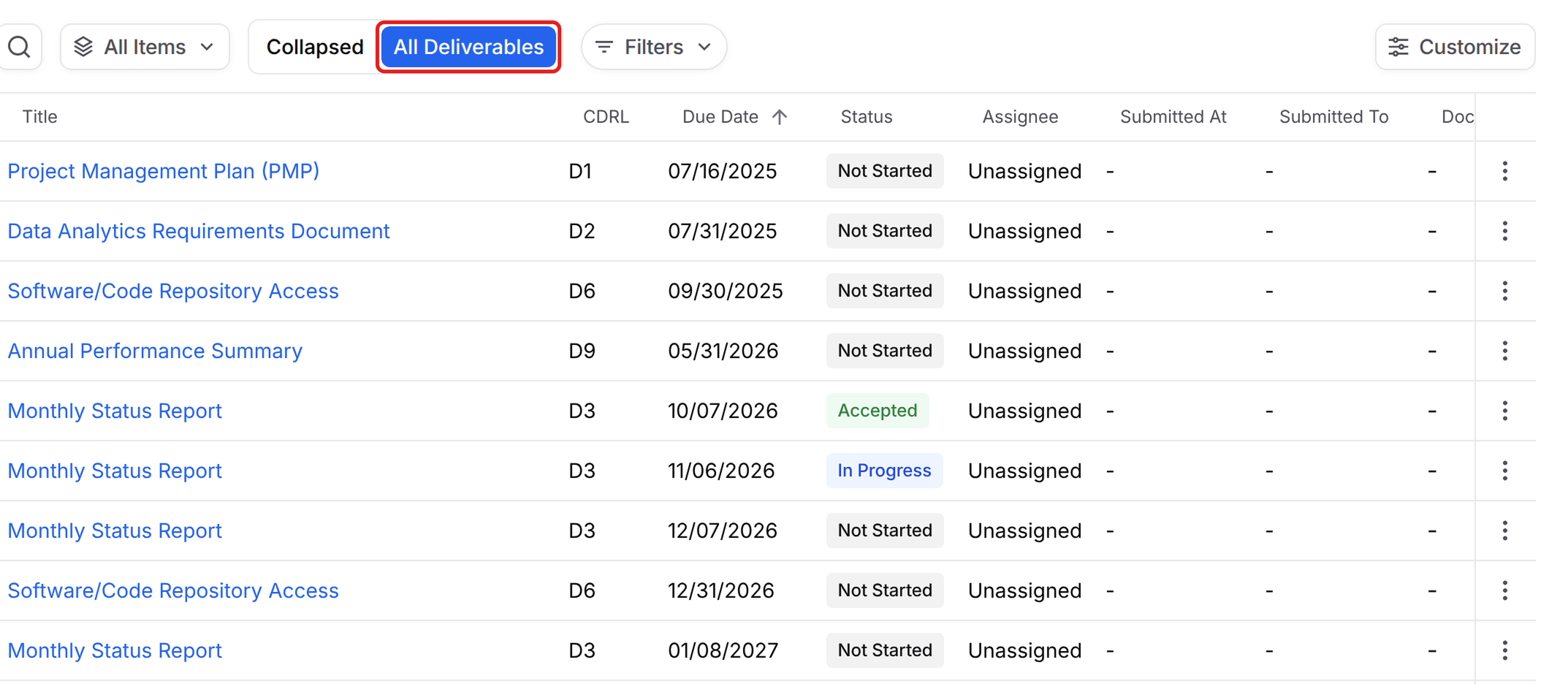
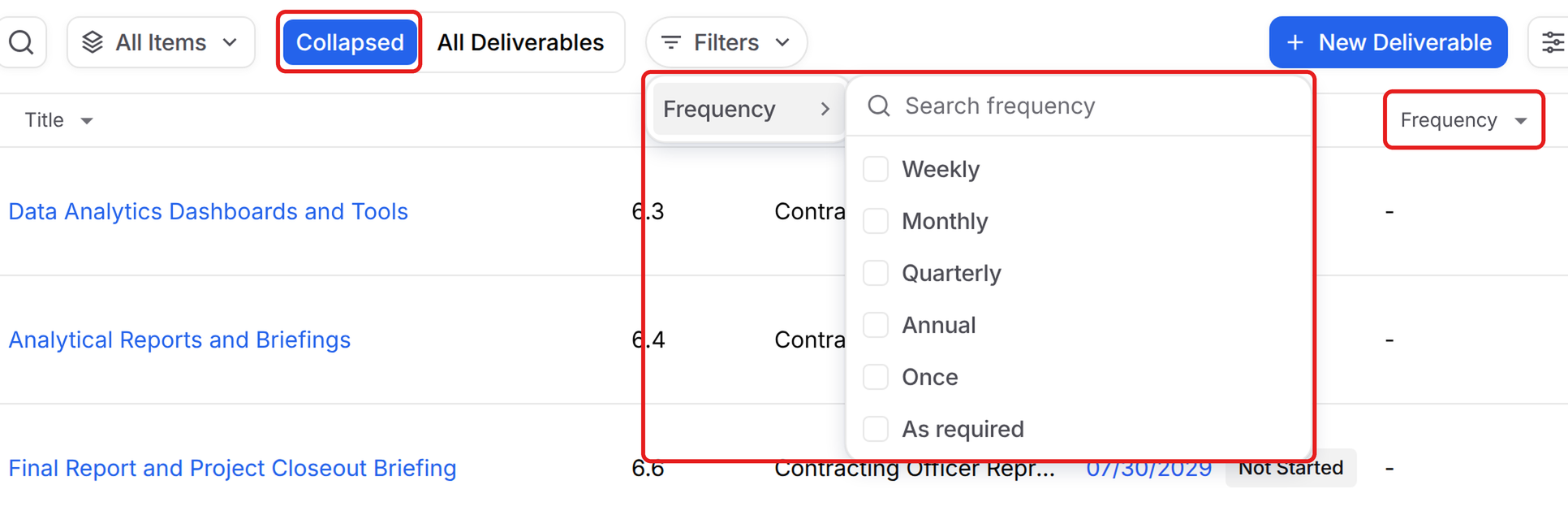
Open a contract from your inventory and click Deliverables in the left menu. Use the toggle above the table to switch views:
View | What it shows |
|---|---|
Collapsed | One row per requirement. The Next Due column shows the earliest submission that hasn't been accepted or canceled, with its status. The Frequency column shows how often each requirement is due. Use Filters to narrow by Frequency, or click the Frequency column header to sort. |
All Deliverables | Every submission on the contract. Use Filters to narrow by Status, Submitted to, Due date or Submitted. |
Each view can have its own saved views, so you can keep filters like overdue submissions one click away. See Saved Views.
Adding a Deliverable Requirement
In the Collapsed view, click New Deliverable.
Enter a Title. CDRL and Description are optional. Default assignee is set to you. Choose another team member, or clear it to leave the requirement Unassigned.
Click Create requirement.
Open the requirement and, under Details, choose the Recipient: the contract's Points of Contact role that receives this deliverable, such as Contracting Officer Representative. You can also change the Default assignee there.
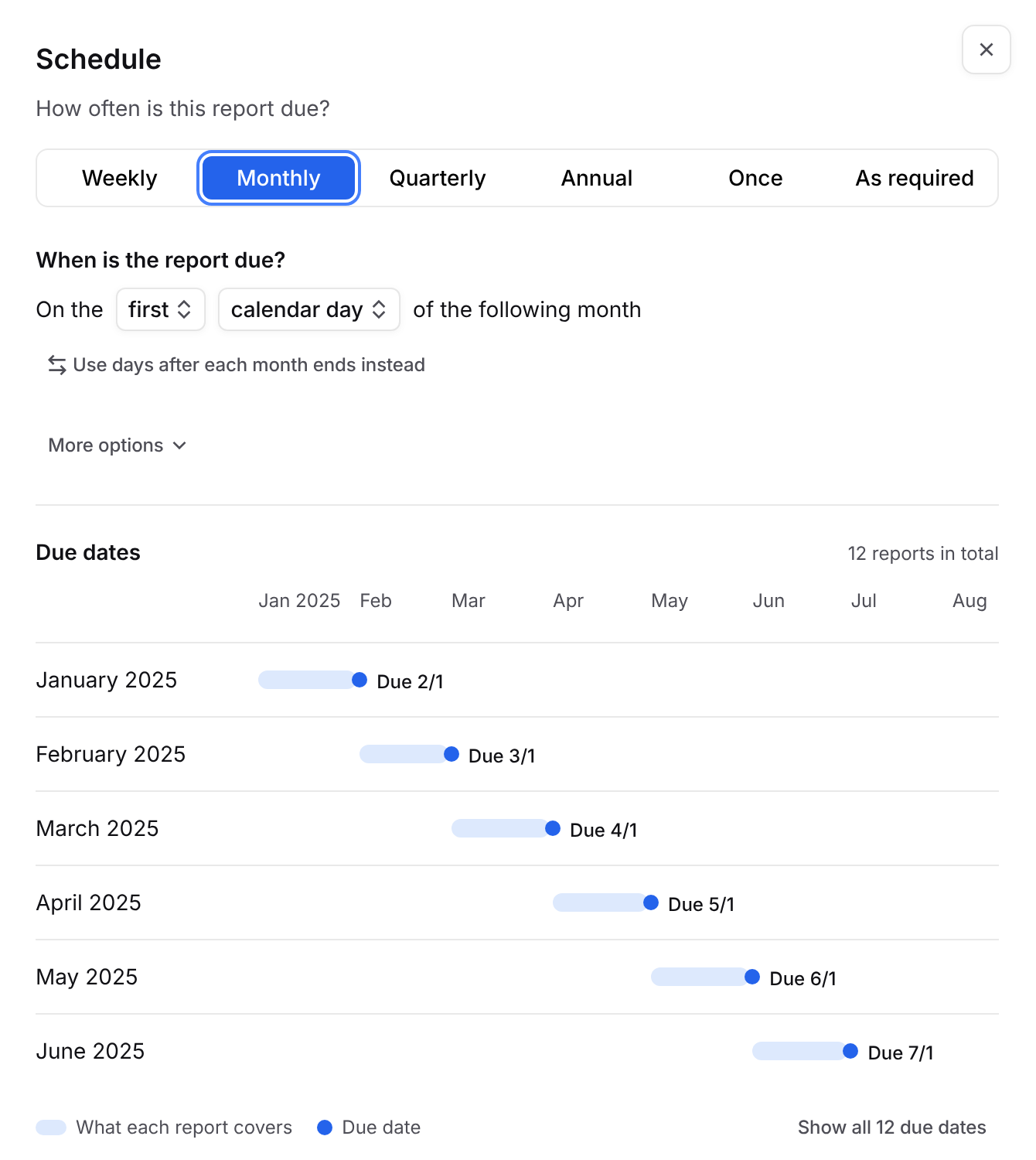
To set when it's due, click the Schedule card, which shows No schedule until you add one. Under How often is this report due?, choose Weekly, Monthly, Quarterly, Annual, Once or As required, fill in when it's due, check the Due dates preview, then click Save.
You can edit the title and description directly on the requirement page. Changes save automatically.
The Schedule card then shows the schedule and the next due date. Schedules that count from the contract's period of performance need those dates on the contract. If one is missing, the card tells you which date to add.
Adding Submissions
Open the requirement.
In the Submissions section, click New submission.
Optionally set a due date, then click Create submission. For an As required deliverable, pick the date under When did the event happen? instead, and GovDash sets the due date from the deliverable's schedule.
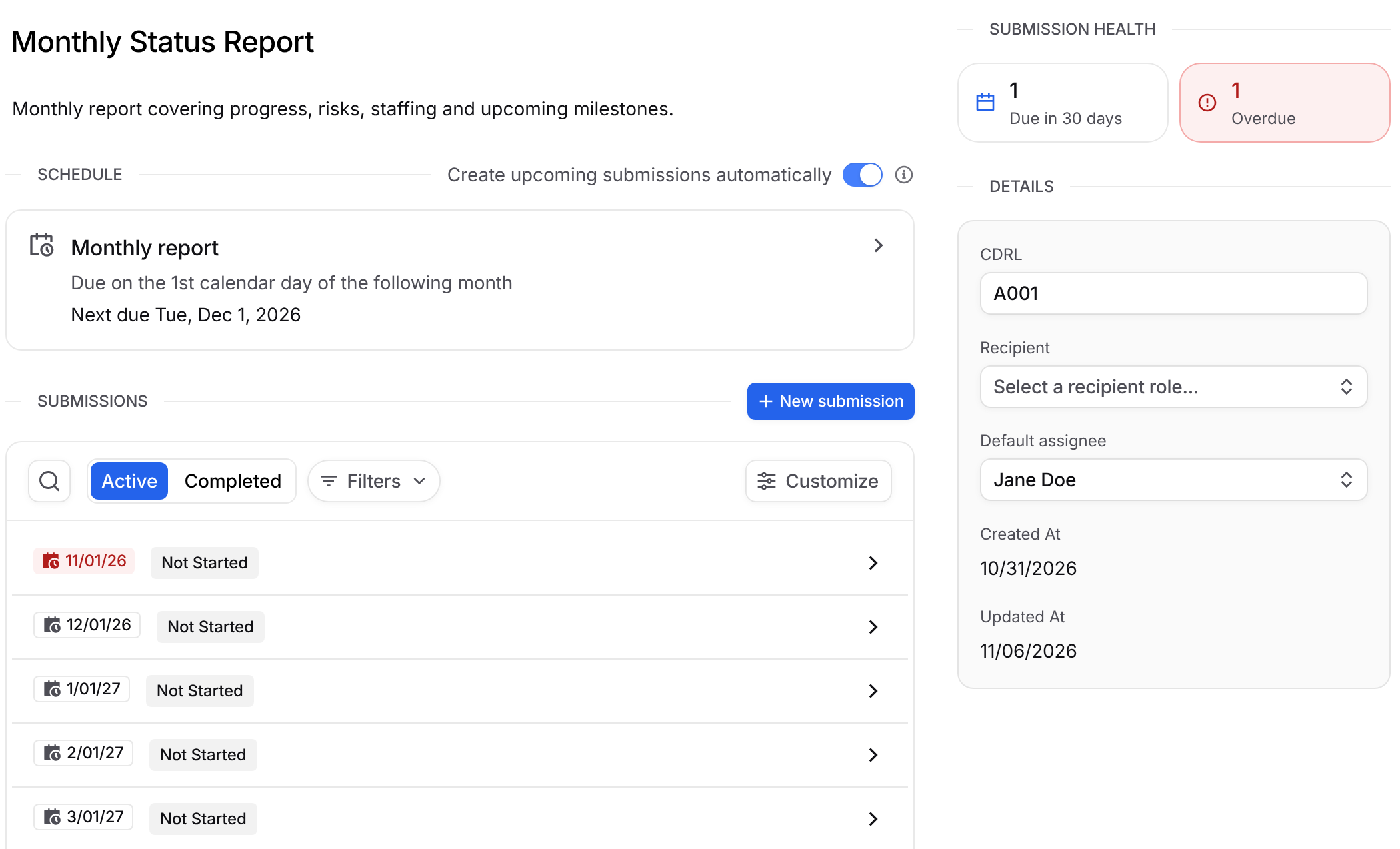
If the requirement has a schedule other than As required, GovDash creates a submission for each of the next 5 due dates and updates them when the schedule changes. As due dates pass, GovDash adds the next ones each day, and if the contract's period of performance changes, upcoming submissions move to match. Submissions someone has already started are never changed. To add submissions yourself instead, turn off Create upcoming submissions automatically next to the Schedule heading. Turning it on or off is recorded in the contract's Audit Log. Without a schedule, add one submission for each time the deliverable is due.
Use the Active and Completed toggle to switch between open submissions and accepted or canceled ones.
The requirement page also shows a Submission health summary when any submissions need attention: Due in 30 days and Overdue count submissions that haven't been submitted yet, Pending acceptance counts those that are Submitted or Under review, and Rejected counts rejected submissions.
Tracking a Submission
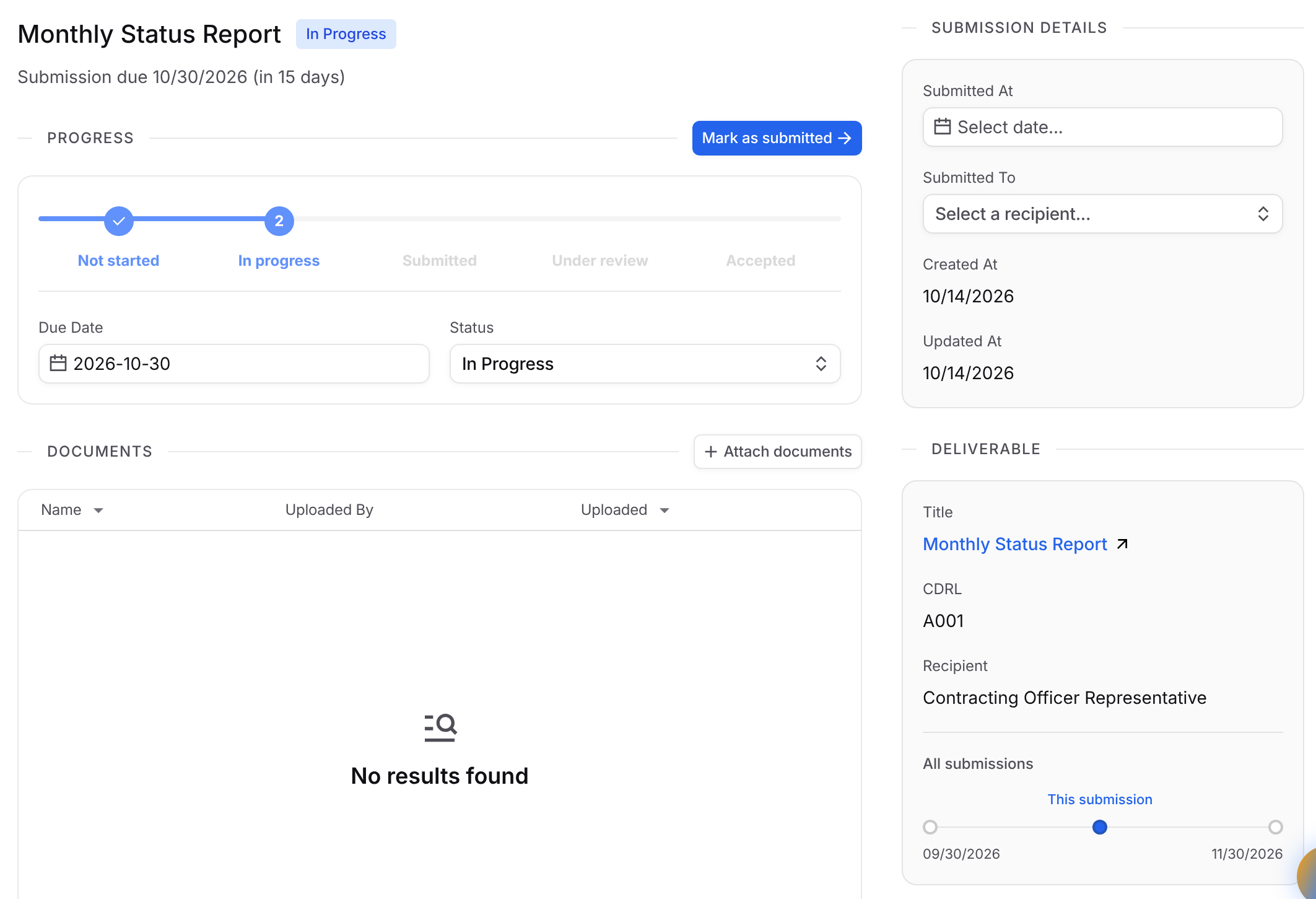
Open a submission to see its Progress. Each submission moves through Not started, In progress, Submitted, Under review and Accepted. Click the button in the Progress section to move it to the next step:
Current status | Button | New status |
|---|---|---|
Not started | Start working | In progress |
In progress | Mark as submitted | Submitted |
Submitted | Mark under review | Under review |
Under review | Mark accepted | Accepted |
Rejected | Start revision | In progress |
You can also pick any status, including Rejected and Canceled, from the Status field. When you click Mark as submitted, Submitted At is set to today if it is empty.
Use Canceled for a submission that is no longer due, such as a skipped reporting period. It stays on the requirement under Completed, doesn't count as overdue or as the next due date, and has no next step button. If the requirement has a schedule, GovDash doesn't create that submission again.
On the same page you can:
Set Submitted At and Submitted To (the person who received it) under Submission details.
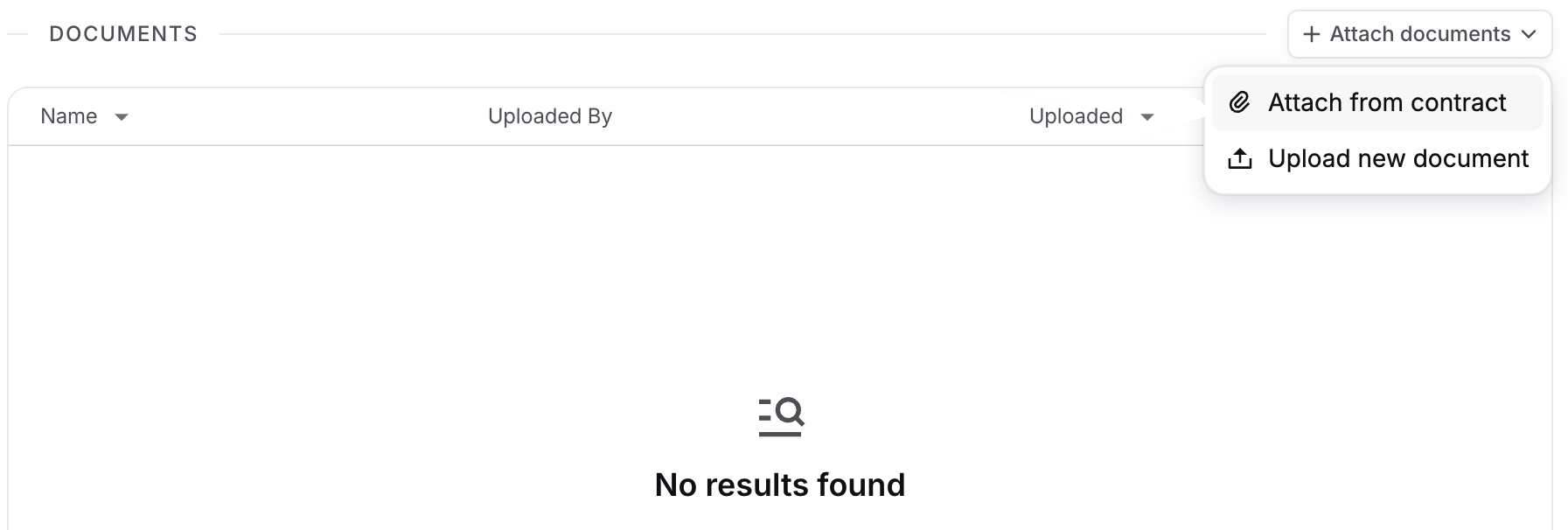
Click Attach documents to add the files you delivered. Choose Attach from contract to pick files that are already on the contract, or Upload new document to upload a file or add one from SharePoint, Google Drive or the Data Library.
Use All submissions to jump to other submissions of the same requirement.
Who Can Edit
Anyone who can edit the contract can add and update deliverables.
Deleting Deliverables
Open the row's actions menu and choose Delete requirement or Delete submission. Deleting a requirement also permanently deletes all of its submissions, so you'll be asked to type the requirement's name to confirm.
Using Dash with Deliverables
Dash can list, create, update and delete deliverable requirements and submissions on a contract, set when each requirement is due, and attach documents already in GovDash to a submission. For example, ask Dash to add a monthly status report that's due 10 days after each month ends. Dash also understands contract shorthand such as MTHLY, 10 DARP or ASREQ.
To set up a contract quickly, click Find deliverables with Dash on the contract's Deliverables page before you add any deliverables. Dash reads your contract documents and adds the deliverables it finds, including when each one is due.